




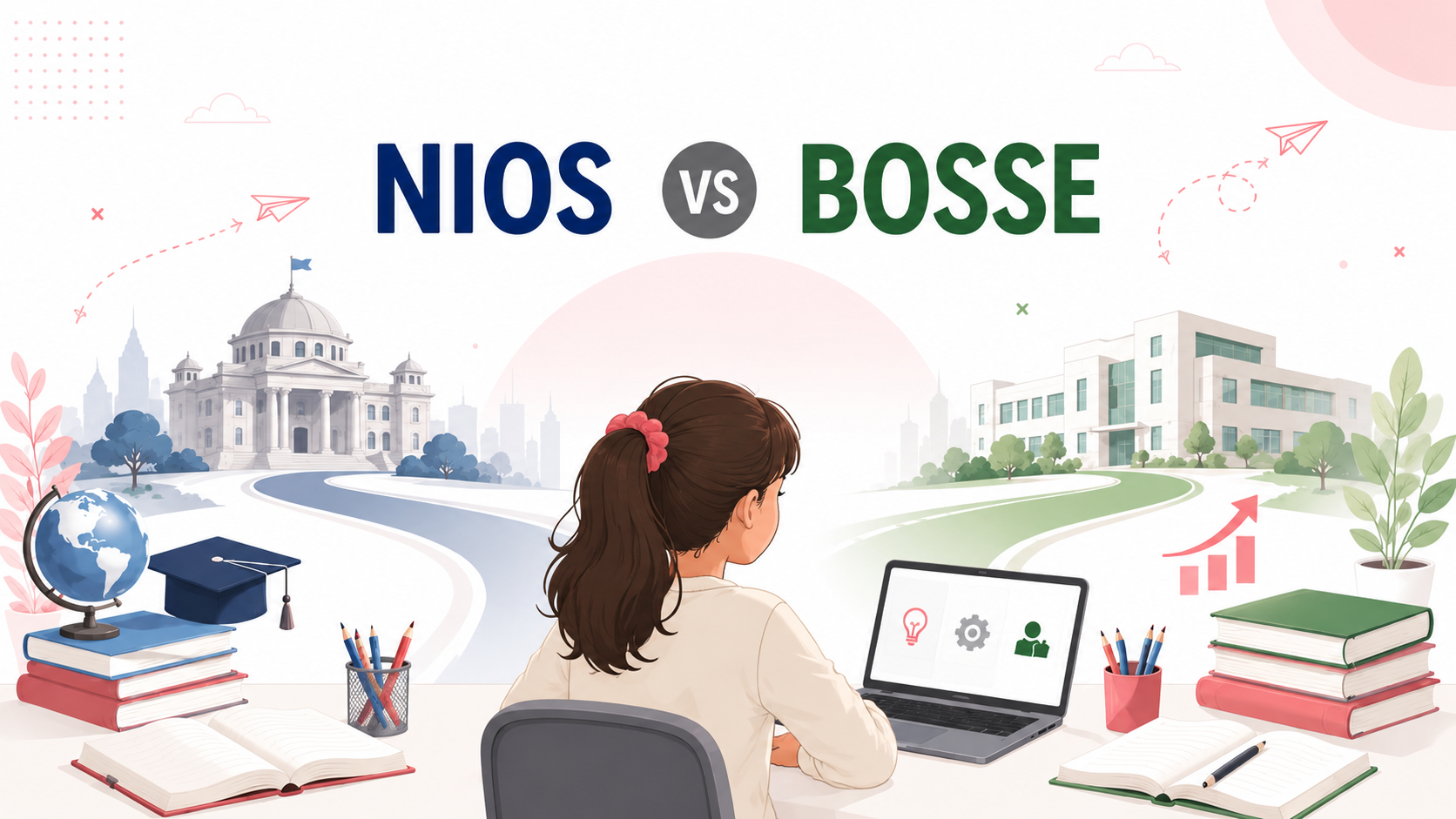
Most parents arrive at open schooling by relief rather than by plan. The pressure of a conventional school had become too much, or the timetable stopped fitting into the family schedule, and someone mentioned that there is another way to earn a proper, recognised Class 10 or 12 certificate without sitting in a classroom from 8 am to 3 pm. Then comes the next question, and it is a good one. NIOS or BOSSE?
If you have been quietly confused about the difference, you are in excellent company. Both are open schooling boards. Both let your child learn flexibly and still walk away with a recognised qualification. But they are not identical, and the right one depends on your child’s situation more than on which name sounds more familiar. Let me untangle it.
First, what they share
Before the differences, the common ground, because it is reassuring. Both NIOS and BOSSE are legitimate, recognised boards, not shortcuts or workarounds. Both let a student choose subjects, learn at a humane pace, and sit exams without the daily grind of a physical school. Both issue certificates that are accepted for higher education and employment in India.
So whichever way you lean, you are not choosing between a real qualification and a lesser one. You are choosing between two real ones with slightly different characters.
NIOS: the established giant
The National Institute of Open Schooling is a Government of India board under the Ministry of Education, and it is the largest open schooling system in the world. That scale is the headline fact. When a college clerk or an employer sees NIOS on a certificate, there is no hesitation and no explaining to do. It is thoroughly familiar, comfortably at par with CBSE and ICSE, and recognised by the Association of Indian Universities.
For your child, NIOS opens the doors that matter. NIOS students are eligible for JEE Main and JEE Advanced, and for NEET, provided they meet the subject requirements. It offers real flexibility too, including the ability to carry forward subjects you have already passed and to sit certain exams on demand rather than waiting a whole year.
The trade-off is the trade-off of any very large institution. Processes can feel bureaucratic, and the sheer size means you are one of an enormous number. None of that undermines the qualification. It simply means you sometimes navigate a big system rather than a nimble one.
BOSSE: the newer, flexible challenger
The Board of Open Schooling and Skill Education is younger. It was established by the Government of Sikkim under a 2020 state Act, so it does not carry NIOS’s decades of name recognition. What it does carry is a genuine set of recognitions that surprises parents who assume newer means weaker.
BOSSE is a member of the Council of Boards of School Education in India, and it has been granted equivalence by the Association of Indian Universities for higher education and employment. It has been recognised by NIOS itself, by the National Medical Commission, the Pharmacy Council and the Nursing Council, and it has appeared on IIT Kanpur’s list of eligible boards for JEE Advanced. Its documents sit on DigiLocker. In plain terms, on paper, it holds the recognitions that matter.
Its character is flexibility and a skills-forward outlook, with a student-friendly examination model and a strong emphasis on vocational learning alongside the academic subjects. For some families, that modern, adaptable feel is exactly the draw.
The honest caveat is about familiarity, not validity. Because BOSSE is newer, an occasional admissions officer or employer will not recognise the name on sight and may ask questions or want to see the recognition documents. That is usually a five-minute conversation, not a closed door, but it is a conversation NIOS families rarely have to have.
So which one?
Here is how I would think it through, plainly.
Lean towards NIOS if your child is heading into competitive entrance exams, JEE or NEET, or into a conventional Indian degree, and you want the certificate that is recognised instantly and everywhere with zero friction. Its scale and long track record are precisely the reassurance you want when the stakes are high, and you would rather not explain anything to anyone.
Lean towards BOSSE if you value flexibility and a skills-integrated approach, if the modern examination model suits your child, or if a particular BOSSE feature fits your situation neatly. Just go in clear-eyed that you may occasionally need to show its recognition paperwork, and keep those documents handy.
For most families whose priority is the smoothest possible road to an Indian university or a national entrance exam, NIOS is the more conservative, lower-friction choice, and there is no shame in choosing the well-worn path when your child’s future is riding on it. For families drawn to flexibility and skills, and comfortable with a board that is still building its household name, BOSSE is a genuinely credible option rather than a compromise.
One thing that matters more than the board
After years of watching families make this choice, I will tell you something that outweighs the NIOS-versus-BOSSE debate. The board decides what certificate your child earns. The support around your child decides whether they earn it well.
A student left alone with either board’s self-study materials often drifts. A student with structured live teaching, a timetable, and someone checking in tends to thrive on either. So while you weigh the boards, weigh the support even more heavily. That is where a good online school earns its place, by wrapping proper teaching and pastoral care around whichever board you pick.
At The World Ecademy, we work with both NIOS and BOSSE, which means we can be honest with you rather than steering you towards the only board we happen to offer. Tell us about your child, their goals, and their timeline, and we will help you choose the board that actually fits. Book a free board-selection consultation, and let us take the guesswork out of it.