







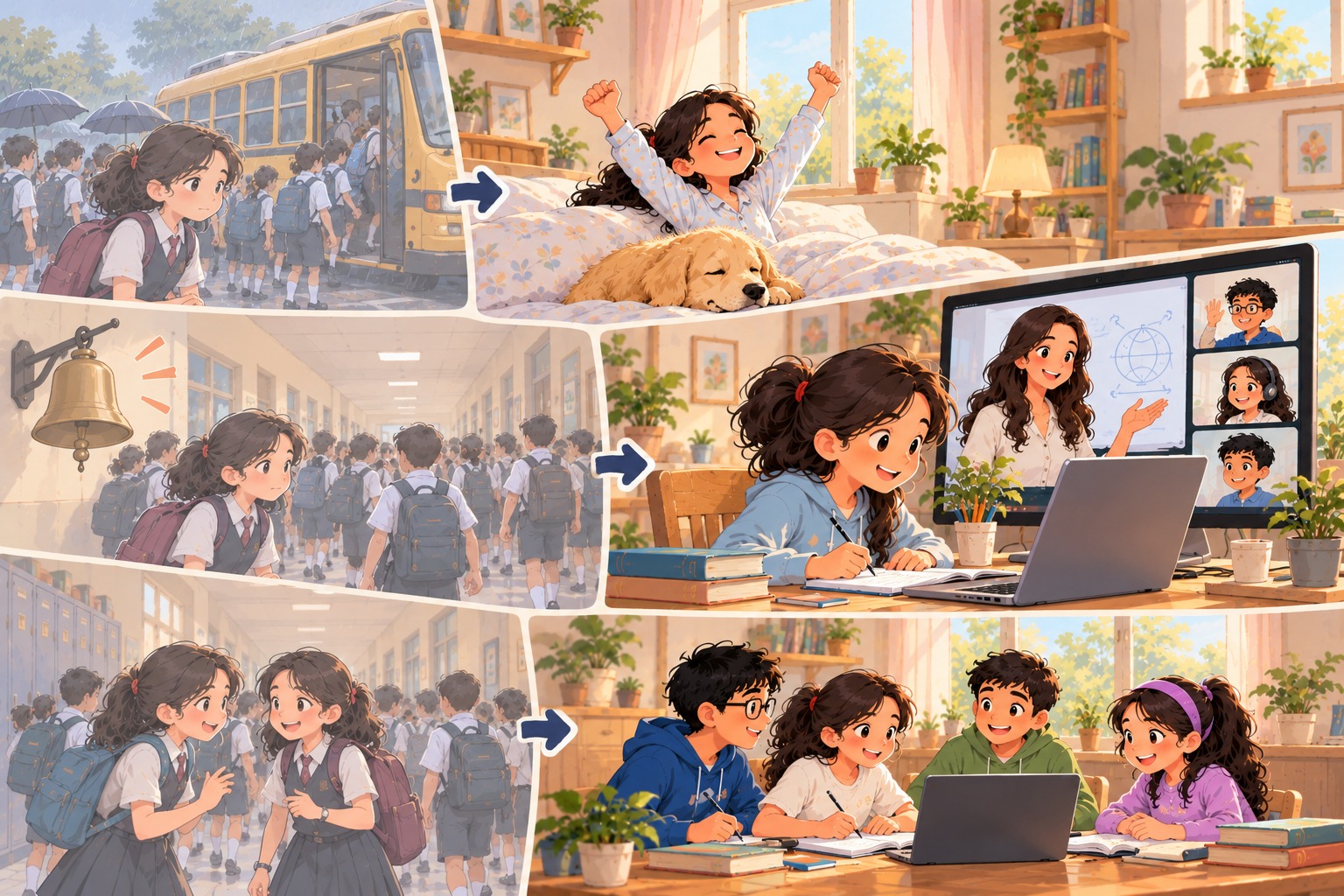
For most of us, school had a sound. The hiss of the bus doors at the end of the lane. The bell that cut a sentence clean in half. The roar of a corridor at break — hundreds of children all talking at once, and nobody quite listening.
Take those sounds away, and many parents assume the school goes with them.
It does not.
The bus, the bell and the corridor were never the school. They were simply how we got there.
No school bus
Early on any weekday morning, a great many children are already gone. Out of the door with a half-eaten piece of toast, a bag that weighs more than it should, waiting at a stop in the rain or the heat. By the time they sit down for the first lesson, they have spent the best of their morning energy simply arriving.
In an online school, that time comes home. A child wakes at a sensible hour. Eats breakfast sitting down. Says goodbye to a parent rather than to the back of a bus. Walks ten steps to a desk — and is ready.
It sounds like a small thing. Ask any parent who has stood at a bus stop in the monsoon whether it is small.
Every minute not spent getting to school is a minute a child can spend learning, resting, or simply being with family.
No bell
The bell is a curious tyrant. It rings when the clock says so, not when the thinking is done. A child finally grasps fractions — and the bell goes. A debate catches fire — and the bell goes. Thirty children pack up a half-formed idea and carry it, crumpled, to the next room.
An online school day still has a timetable. Lessons begin on time. Breaks are real. But the edges are softer. A teacher can let a good discussion breathe for a couple more minutes. A child who needs a moment longer to finish a thought can have it. The day moves at the pace of understanding, not the pace of a buzzer on the wall.
And no bell does not mean no order. Quite the opposite. Without a bell telling them when to move, children slowly learn to watch the clock themselves — to plan, to be ready, to turn up on time because they have chosen to, not because a noise demanded it.
A bell teaches children to obey time. A good online day teaches them to own it.
No corridor
This is the one that gives parents pause. The corridor was where friendships happened. Where you found your best friend by the lockers. Where you laughed, whispered and swapped the news between lessons.
It was also, for some children, the most frightening place in the building. The crush. The noise. The unkind comment no teacher heard. The child walking quickly, head down, counting the steps to the next classroom.
Online, the corridor does not vanish — it changes shape. Friendships grow in breakout rooms and group projects, in clubs that meet after lessons, in the easy chatter before a class begins. Children find their people by what they love, not by whose locker happens to sit next to theirs. And because every space is one a teacher can see, the unkindness that used to hide in the crowd has far fewer places to hide.
Children do not need a corridor to make friends. They need a safe place to be themselves.
So what is left, once the bus, the bell and the corridor are gone?
Everything that mattered. A teacher who knows each child by name. A class that comes together, live, every morning. Lessons with structure and stretch. Someone who notices when a child goes quiet — and someone who celebrates when they finally get it.
What is left is a school day stripped back to its heart — teaching, learning and belonging — without the noise that so often drowned them out.
Take away what was only ever the packaging, and you find what was always the gift.
At the end of the day, there is no bus to home. No bell to signal freedom. No last scramble down the corridor. A laptop closes, a child stretches, and they are already where they need to be. Home. Not frazzled. Not worn thin. Still curious.
Different? Certainly. Lesser? Not for a moment.
If school could give your child everything that matters — and leave out everything that wears them down — would you really miss the sound of the bell?